

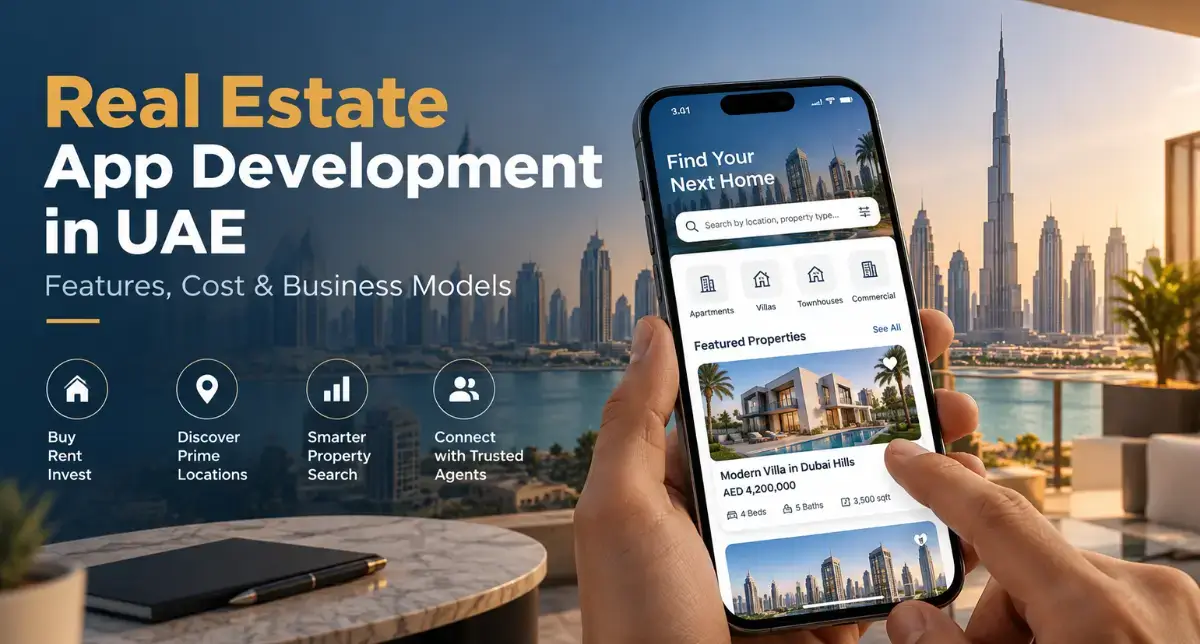
The way people search for property in the UAE has changed significantly. Buyers and tenants no longer depend entirely on property boards, newspaper listings, or repeated calls to different real estate agents. They can now explore communities, compare prices, view property images, check floor plans, save listings, and contact agents directly from their smartphones.
For real estate businesses, this shift has created opportunities beyond simply putting property listings online. A well-planned mobile application can connect buyers, tenants, investors, agents, developers, and property managers within one digital environment. It can also help businesses generate qualified enquiries, understand user behaviour, promote projects, and create new revenue streams.
This is why real estate app development in UAE should be approached as a product strategy rather than simply a software project. Businesses need to understand who will use the application, what part of the property journey it will improve, and how the platform will generate value before deciding which features to develop.
At DeviceBee Technologies, we see this as the foundation of successful PropTech development. Whether the idea is inspired by an app like Bayut, an app like Property Finder, or an entirely new real estate concept, the objective should be to build around a genuine market need instead of copying an established platform.
What is a Real Estate Mobile App?
A real estate mobile app is a digital platform designed to simplify one or more parts of the property journey. The most familiar examples are property marketplaces where users search for homes to buy or rent, but the category is much broader than property listings alone.
Real estate applications can be developed for property developers, brokerage firms, landlords, tenants, investors, property managers, or commercial real estate companies. A developer may use an application to showcase off-plan projects and manage buyer enquiries, while a property management company may need tenant communication, maintenance requests, payments, and portfolio management.
The right application structure therefore depends on the business model. A marketplace containing properties from hundreds of agents requires a different architecture from an application created by a single developer to market its own projects. Defining this distinction early prevents unnecessary features from increasing development complexity and cost.
Why Real Estate Apps Are Becoming Important in the UAE?
The UAE has a highly active real estate sector with buyers, tenants, investors, developers, and brokers from many different markets. Dubai, Abu Dhabi, and other emirates attract both local and international property interest, making digital accessibility particularly important for businesses trying to reach customers beyond their physical offices.
Dubai’s real estate infrastructure is also becoming increasingly digital. Dubai Land Department provides services through platforms such as Dubai REST, while property information, digital services, and data are becoming more integrated into the wider real estate journey. These developments create an environment where customers increasingly expect property businesses to offer convenient digital experiences.
For users, convenience is only one part of the expectation. They also want better information before contacting an agent. Location, property condition, amenities, floor plans, community information, price context, agent credibility, and availability can all influence whether someone decides to make an enquiry.
A useful real estate application brings these elements together so users can move naturally from property discovery to comparison and eventually to communication with an agent or developer.
Building an App Like Bayut: What Should Businesses Learn?
Bayut is one of the most recognizable property platforms in the UAE, so it is understandable that businesses considering a real estate application often use it as a reference. However, building an app like Bayut should not mean recreating the same interface and feature set.
The more valuable approach is understanding the problems those features solve. Property filters help users narrow large inventories, map-based discovery adds location context, saved searches make repeat visits easier, and agent communication tools connect digital discovery with an actual property enquiry.
Established platforms have also expanded beyond basic property listings. Features related to market information, property valuation, recommendations, and AI-assisted discovery demonstrate how PropTech is gradually moving from simple property search toward helping users make better-informed decisions.
A new real estate business does not need every advanced feature in its first release. Instead, it should identify a specific customer problem where it can provide a stronger experience. This could involve luxury property, off-plan developments, commercial real estate, verified listings, investment opportunities, or a highly specialized geographic market.
Developing an App Like Property Finder
Property Finder provides another useful reference for understanding how people search for real estate digitally. Its platform combines property inventory with filters, community information, agent connections, and other resources that support users as they move from initial research toward contacting a real estate professional.
Businesses considering an app like Property Finder should again focus on the product logic rather than visual imitation. A successful marketplace needs reliable inventory, fast search, useful filters, strong location information, good listing presentation, and a simple path from property discovery to enquiry.
There is also room for differentiation. A new platform could specialize in developer-direct inventory, off-plan investment opportunities, rental properties, commercial spaces, luxury villas, or AI-assisted property matching. Another business might avoid the marketplace model entirely and build a dedicated application for its own projects and customers.
The strongest concept is usually one that has a clearly defined audience. When the target user is understood, the development team can prioritize the features that genuinely support that person’s property journey.
Essential Features of a Real Estate App in the UAE
Property search and filtering are usually central to a marketplace application. Users may want to search according to emirate, community, property type, price, bedrooms, bathrooms, furnishing, amenities, or whether a property is ready or off-plan. Search performance is especially important when a platform contains thousands of active listings.
Map-based discovery adds another layer to this experience. Property decisions are strongly influenced by location, so allowing users to understand where a home sits in relation to schools, workplaces, transport, shopping, healthcare, and other amenities can make listings considerably more useful.
Each property page should also provide enough information for someone to evaluate whether the listing deserves further attention. High-quality photographs, videos, floor plans, property specifications, amenities, price information, location details, developer information, and agent details can all contribute to a more complete experience.
For premium properties or off-plan developments, businesses may also consider virtual tours, 360-degree views, interactive floor plans, or other visual experiences. These features can be particularly valuable for overseas investors who may begin their property search before travelling to the UAE.
Verified Listings and User Trust
Trust is an important part of any property marketplace. Users can quickly lose confidence when they repeatedly encounter duplicate properties, outdated listings, incorrect prices, or properties that are no longer available.
A real estate application should therefore include appropriate processes for listing moderation and verification. Depending on the platform, this may involve agent verification, agency profiles, property documentation, listing status controls, reporting tools, or administrative review.
The objective is not simply to display more inventory. A smaller collection of reliable and well-presented listings can provide a better user experience than a large database filled with outdated or questionable information.
Trust can also be strengthened through transparent agent profiles. Showing relevant information about the agent or agency gives users more context before they make contact and can help create accountability across the marketplace.
Saved Properties, Alerts and Repeat Engagement
Property searches rarely finish during a single session. A buyer may spend several weeks comparing communities, reviewing different property types, monitoring prices, and discussing options before deciding to arrange viewings.
Favourites and saved searches make this process easier by allowing users to return to properties they are genuinely considering. Notifications can extend the experience further by informing users about new listings, price changes, or properties that match previously saved criteria.
These features are valuable for the business as well because they encourage repeat engagement. Instead of depending on users to remember to reopen the application and perform the same search, the platform can bring relevant opportunities back to their attention.
Notifications should still be carefully controlled. Too many irrelevant alerts can lead users to disable notifications entirely, so personalization and user preferences should be considered as part of the feature design.
Agent Communication and Lead Generation
A property application becomes commercially useful when discovery can turn into meaningful enquiries. Users should be able to contact an agent, send a message, request more information, or arrange a viewing without navigating through unnecessary steps.
For agencies and developers, these enquiries should ideally connect with a structured lead-management system. Integrating the application with a CRM can help sales teams track where leads originated, which properties generated interest, whether follow-up has occurred, and how prospects progress through the sales process.
This creates a more complete digital journey from property search and listing views to enquiries, viewings, follow-ups, and eventual conversion. The application then serves both the customer’s discovery needs and the business’s sales process.
How AI Can Improve Real Estate Mobile Apps?
Artificial intelligence can make property discovery more useful when it is applied to a specific customer problem. One of the clearest opportunities is personalized property recommendations based on search behaviour, saved properties, preferred communities, budgets, and other relevant signals.
Natural-language search could also make complex property requirements easier to express. Instead of manually selecting several filters, a user might search for a family-friendly villa within a particular budget, close to schools and within a preferred area. The application could interpret those requirements and return suitable properties.
AI can also support customer service, lead qualification, property descriptions, data interpretation, and market insights. For agents and developers, automation may help organize enquiries or identify leads showing stronger purchase intent.
However, AI should not be added simply because it is currently popular. The feature should improve discovery, reduce manual effort, or help users understand information more easily. If a standard search or rule-based workflow solves the problem effectively, introducing unnecessary AI may only increase development complexity.
Business Models for Real Estate Apps
A real estate application needs a clear commercial model if it is intended to operate as an independent digital business. Property marketplaces commonly generate revenue through agent or agency subscriptions, where businesses pay to publish a certain number of listings or access additional platform features.
Featured listings provide another option. Agents and developers can pay for greater visibility within relevant searches or project sections. Lead-generation models can also work when the platform is capable of delivering qualified property enquiries to agencies, brokers, or developers.
Some platforms may generate revenue through developer packages, advertising, or partnerships with businesses such as mortgage providers and home-service companies. Another option is a SaaS model, where the technology is provided to individual agencies or developers as their own digital property platform.
The business model affects the product itself. Subscription management, featured placement, payments, analytics, lead tracking, and user permissions may all need to be included in the application architecture depending on how revenue will be generated.
How Much Does Real Estate App Development Cost in the UAE?
The estimated cost of real estate app development in the UAE typically ranges from AED 50,000 to AED 300,000+, depending on the features, platforms, integrations, design complexity, and backend requirements. A focused MVP with property listings, search filters, maps, favourites, agent profiles, enquiries, and an admin dashboard can generally start from around AED 50,000 to AED 100,000.
A more advanced real estate application with multiple user roles, CRM integration, real-time notifications, property comparison, advanced search, analytics, and chat functionality may cost approximately AED 100,000 to AED 250,000. Businesses planning a large-scale app like Bayut or Property Finder should expect a higher investment, potentially AED 250,000 to AED 500,000+, especially when AI recommendations, virtual tours, multilingual functionality, large property databases, and complex third-party integrations are required.
These figures are planning estimates rather than fixed prices. At DeviceBee Technologies, we recommend defining the MVP first and adding advanced functionality in later phases. If your requirements are already available, you can get an estimate based on your actual project scope.
Planning the Right MVP
An MVP should contain enough functionality to prove the core product idea without attempting to reproduce every feature offered by established property platforms. The goal is to create a complete primary user journey rather than a large collection of partially developed features.
For a property marketplace, that journey might allow a user to create an account, search by location and budget, apply relevant filters, review a detailed property listing, save suitable options, and contact an agent. Agents would need the ability to manage listings and enquiries, while administrators would require control over users, properties, and platform activity.
Once the application is being used, analytics and customer feedback can guide the next development phase. If users regularly use map search, that experience can be expanded. If saved searches generate strong repeat engagement, alerts can become more personalized. Product decisions become stronger when they are based on actual behaviour rather than assumptions.
Choosing a Mobile App Development Company in UAE
Developing a real estate platform requires expertise across more than the mobile interface. Property databases, search architecture, maps, backend systems, APIs, CRM connections, media performance, notifications, analytics, security, user roles, and administration all need to work together.
A capable mobile app development company in UAE should therefore understand the business model before recommending a technical solution. The technology stack should support the expected number of users, listing volume, integrations, monetization strategy, and future product roadmap.
At DeviceBee Technologies, we begin real estate app development by understanding the audience and the commercial purpose behind the application. This helps determine which features belong in the first release, which integrations are essential, and which capabilities can be introduced as the platform grows.
Whether the requirement is an app like Bayut, an app like Property Finder, a developer-specific property application, an off-plan marketplace, or a new PropTech concept, our focus is on developing a product around the business rather than simply reproducing an existing application.
Build Your Real Estate App With DeviceBee Technologies
The UAE real estate market creates opportunities for many different digital products. A brokerage may need a better way to generate and manage mobile leads, while a developer may want to present projects directly to international investors. A startup may see an opportunity to improve property discovery, investment analysis, rentals, or another underserved part of the market.
DeviceBee Technologies can help take that concept through product planning, UI/UX design, mobile development, backend development, API integration, testing, deployment, and ongoing improvement. Our approach is to determine what the product needs to achieve commercially before deciding how the technology should be implemented.
If you have a real estate application idea and want to discuss the required features, target users, integrations, and development roadmap, Contact Us to speak with our team. If your concept is already defined and you want to understand the likely scope and development budget, you can get an estimate for your project.
The Future of Real Estate App Development in the UAE
Real estate technology in the UAE is moving beyond simple online listings. Property discovery is increasingly connected with market data, digital services, AI, virtual experiences, personalized recommendations, and more convenient communication between property seekers and real estate professionals.
This creates an opportunity for businesses to develop applications that support more of the customer journey. Instead of ending at property discovery, future platforms can help users compare options, understand communities, communicate with professionals, arrange viewings, manage documentation, and remain connected after a transaction.
Bayut and Property Finder provide useful examples of how large property platforms can evolve, but a new real estate application does not need to imitate either platform to succeed. A specialized product can create value by solving a narrower problem particularly well, serving a specific customer segment, or connecting parts of the property journey that currently remain fragmented.
For businesses planning real estate app development in UAE, the strongest starting point is therefore not the number of features that can be developed. It is understanding the customer problem, building the right first version, and creating a technology foundation capable of growing with the business.