

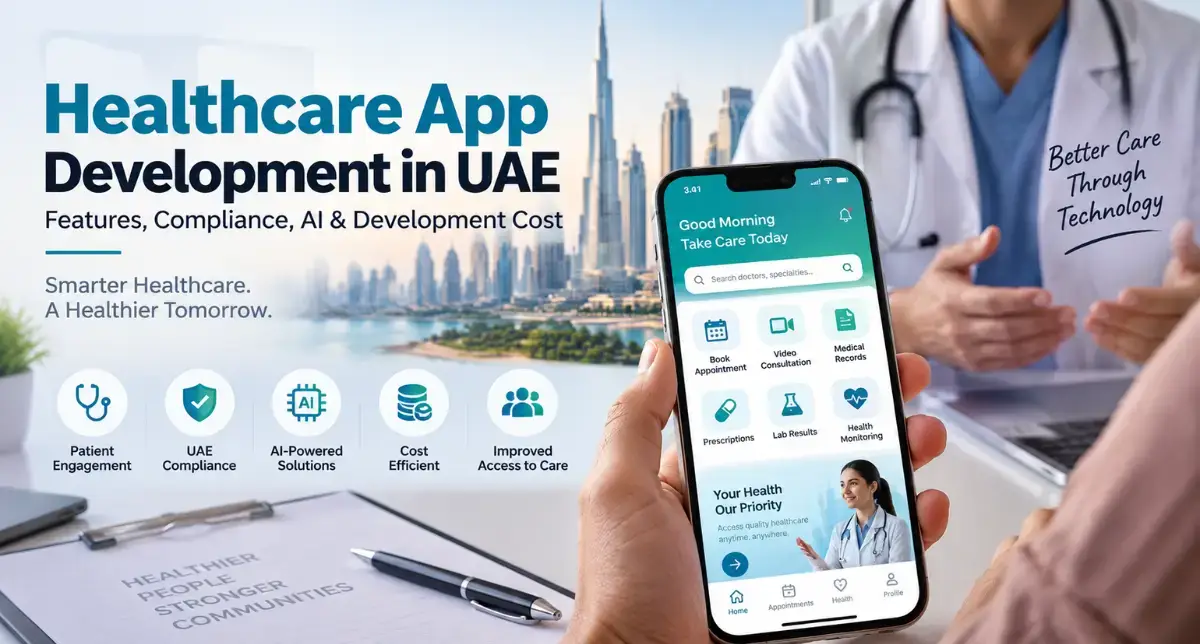
Healthcare is one of the industries where we believe a mobile application cannot be treated as just another digital product. When patients use an app to book a doctor, attend a video consultation, access medical information, manage medication, or monitor their health, they are trusting that technology with something much more important than convenience.
For a hospital, clinic, healthcare startup, pharmacy, or health-tech business in the UAE, this creates a significant opportunity. A well-planned healthcare app can remove friction from the patient journey, improve access to services, reduce administrative work, and create better communication between patients and healthcare providers.
But the starting point should not be a long list of features.
At DeviceBee Technologies, when we discuss healthcare app development with a client, we first want to understand the patient problem, the healthcare service behind the application, the information it will handle, and how the product will fit into existing clinical and operational workflows.
Once those decisions are clear, features, AI, integrations, compliance requirements, technology, and development cost become much easier to plan.
What Type of Healthcare App Should You Build in the UAE?
There is no single model for a successful healthcare app. The right product depends on the problem your organization wants to solve and the people who will use it.
A clinic or hospital may need a patient application that brings doctor discovery, appointment booking, reminders, teleconsultations, prescriptions, and selected medical information into one experience. This type of application can reduce the number of separate calls, messages, and systems patients currently use to manage their care.
A telemedicine business has different priorities. Its core journey may begin with finding an appropriate healthcare professional, selecting an available consultation slot, completing the required patient information, attending a secure video consultation, and receiving follow-up instructions.
Pharmacies can explore prescription management, medicine ordering, refill reminders, delivery tracking, and pharmacist communication. Chronic-care platforms may instead focus on medication adherence, symptom tracking, connected devices, regular monitoring, and communication between patients and care teams.
Other healthcare app ideas include home healthcare platforms, diagnostic booking applications, rehabilitation apps, women’s health platforms, mental wellness solutions, elderly-care applications, and corporate health services.
The strongest idea is usually not the application with the most features. It is the one that improves a specific part of the healthcare journey significantly enough that patients and providers have a reason to use it.
What Can We Learn From Leading Healthcare Apps?
When businesses discuss the best healthcare apps, names such as MyChart, Teladoc, and Zocdoc often appear. These products are useful references, but we would not recommend approaching development with the objective of simply reproducing them.
An app like MyChart demonstrates the value of giving patients a connected environment for appointments, health information, test results, communication, and other healthcare interactions.
For telemedicine, an app like Teladoc shows how remote consultations can become a structured digital healthcare service rather than simply a video call.
Appointment discovery presents another use case. An app like Zocdoc demonstrates how technology can help patients find healthcare professionals and schedule appointments more easily. The common lesson across these platforms is that successful healthcare technology removes specific points of friction between patients and the services they need.
In the UAE, Sahatna provides an especially relevant example. Abu Dhabi’s Department of Health describes it as an all-in-one healthcare application providing services including appointment booking, teleconsultations, access to medical records, health assessments, and other healthcare functions. DoH reported that the platform attracted more than one million users during its first year.
If your idea is inspired by one of these platforms, the useful question is not how to copy it. The better question is which part of that experience is relevant to your audience and what your business can do differently or more effectively.
Essential Features of Healthcare Apps for Patients
The feature set should always follow the healthcare journey. However, most healthcare apps for patients need to make it easy for users to access the right service, understand what happens next, and manage relevant healthcare information securely.
Appointment management is often one of the most useful starting points. Patients may need to search by specialty, healthcare professional, facility, location, language, consultation type, or available time. Booking, rescheduling, cancellation, and reminders should work as one connected process rather than separate functions.
Teleconsultation can extend this experience when remote care is appropriate and permitted. The patient should be able to move naturally from an appointment into the consultation and then into relevant follow-up information. Video technology alone does not create a complete telehealth experience.
Medical information can add another layer of value. Depending on the application and available integrations, patients may need access to prescriptions, laboratory results, vaccination information, treatment information, or selected health records.
Useful healthcare mobile apps can also include secure notifications, patient profiles, doctor profiles, medication reminders, multilingual support, payment functionality where appropriate, and accessible communication options. Each feature should have a clear purpose within the patient’s journey.
Where AI Can Improve the Healthcare Experience?
AI has significant potential in healthcare applications, but we believe it should be introduced only where it improves a real workflow. Adding a chatbot or an “AI-powered” label to an application does not automatically make the product more valuable.
One practical use is navigation. A healthcare organization offering many specialties and services can be difficult for patients to navigate. An intelligent assistant may help users understand available services, find relevant information, or move toward the appropriate booking process.
AI can also support administrative automation, document processing, patient engagement, personalized wellness experiences, medication reminders, and the presentation of complex information in a more understandable format. Depending on the application, it may also help organize large amounts of operational data for healthcare teams.
Clinical use requires much greater care. An AI feature that helps a patient locate an appointment is fundamentally different from one that influences diagnosis or treatment. The closer AI gets to clinical decision-making, the more important validation, data quality, human oversight, safety, governance, and regulatory considerations become.
Our approach is therefore to start with the healthcare problem and determine whether AI is actually the right technology for solving it. Sometimes a simpler workflow produces a better and more reliable experience.
Healthcare App Compliance in the UAE
Compliance is one of the areas we recommend discussing before development begins. It can affect architecture, data storage, integrations, access controls, workflows, and even which features can be offered.
Federal Law No. 2 of 2019 concerning the use of information and communication technology in health fields establishes requirements around health information and applies across the UAE, including free zones. UAE government guidance highlights requirements concerning the confidentiality, integrity, and authorized availability of health information.
For applications operating within Abu Dhabi’s healthcare ecosystem, Department of Health requirements can also become relevant. DoH provides a registration process for companies providing healthcare services through mobile applications, with review involving its Facility Licensing division and information security team.
Telemedicine and other digital-health services may introduce additional obligations depending on the activity being provided. Healthcare businesses should therefore obtain appropriate legal, regulatory, and clinical guidance for their specific product rather than assuming that one generic compliance checklist applies to every application.
For the development team, confirmed compliance requirements need to be translated into technical decisions early. Retrofitting important privacy, security, or data-handling requirements after development is significantly less efficient than planning for them from the beginning.
Patient Data Security and Healthcare Integrations
Healthcare applications can process highly sensitive personal and medical information, which makes security part of the product architecture rather than an optional technical layer.
Depending on the application, appropriate controls may include encryption, secure authentication, role-based access, consent management, audit trails, secure APIs, session controls, appropriate data storage, monitoring, backup, and recovery planning.
Abu Dhabi’s AAMEN programme specifically focuses on information security and data privacy standards for healthcare facilities. The emirate also maintains standards supporting the exchange of patient and clinical information within its health information infrastructure.
Integration can become equally important. A healthcare application may need to communicate with hospital information systems, electronic medical records, laboratories, pharmacies, appointment systems, payment services, insurance-related systems, or connected health devices.
The patient may only see a simple screen displaying a laboratory result or prescription, but delivering that information correctly and securely can require several systems to work together behind the interface. Integration planning therefore needs to happen early in the development process.
What Should Your Healthcare App MVP Include?
An MVP does not mean releasing an incomplete healthcare experience. It means identifying the smallest version of the product that can deliver the intended healthcare journey properly while maintaining the required security, privacy, and compliance standards.
For a clinic-focused patient application, an MVP might include secure registration, patient profiles, doctor or specialty discovery, appointment booking, reminders, and appropriate communication functionality. Teleconsultation and selected patient information could also be included when they are central to the service.
A telemedicine platform may require a different MVP involving healthcare professional profiles, scheduling, patient onboarding, secure video consultation, consultation history, and relevant follow-up workflows.
More advanced functionality such as wearable integration, deeper electronic medical record connectivity, AI-assisted experiences, remote patient monitoring, advanced analytics, or sophisticated automation can be introduced according to the product roadmap.
This approach allows businesses to validate how patients and healthcare teams actually use the application before investing heavily in features based primarily on assumptions.
How Much Does It Cost to Build a Healthcare App in the UAE?
The cost to build a healthcare app depends on the type of product, number of user roles, platforms, integrations, security requirements, UI/UX complexity, and whether features such as telemedicine, AI, remote monitoring, or health-record connectivity are required.
As an initial planning range, a focused healthcare MVP may start around AED 60,000 to AED 120,000. A more advanced application involving teleconsultations, multiple user roles, complex backend functionality, deeper integrations, and enhanced security can fall around AED 120,000 to AED 300,000. Large healthcare ecosystems involving extensive integrations, AI functionality, remote monitoring, or enterprise infrastructure can exceed AED 300,000.
These figures should not be treated as fixed quotations. Two applications described as “healthcare apps” can have completely different technical requirements.
At DeviceBee Technologies, we prefer to define the user journey, MVP, integrations, and technical scope before establishing a development budget. If your requirements are already available, you can get an estimate based on the actual scope of your healthcare product.
What Does the Healthcare App Development Process Look Like?
A structured development process helps prevent technical decisions from being made before the healthcare requirements are properly understood.
We begin with product discovery. This stage identifies the target users, business objectives, patient journey, healthcare workflows, required integrations, confirmed compliance considerations, and the functionality needed for the first release.
The next stage involves UX and interface planning. Healthcare applications should be particularly easy to understand because they may be used by people with different ages, technical abilities, languages, and accessibility requirements. The interface should reduce uncertainty rather than add to it.
Architecture, mobile development, backend development, integrations, and testing follow according to the approved scope. Security and healthcare-specific requirements should remain part of these stages rather than being treated as final checks immediately before launch.
Testing also needs to consider complete user journeys. Booking an appointment, receiving a reminder, attending a consultation, accessing appropriate information, or communicating with a healthcare provider should be tested as connected experiences rather than isolated screens.
After launch, product analytics and user feedback can guide future development. Appointment completion, feature adoption, support requests, technical performance, and patient behaviour can reveal where the application needs improvement.
Choosing the Right Healthcare App Development Partner
Healthcare development requires more than the ability to build attractive mobile screens. The development partner needs to understand how patient experience, backend architecture, healthcare systems, security, integrations, scalability, and confirmed regulatory requirements affect one another.
When comparing mobile app development services, healthcare businesses should therefore discuss more than the programming framework or project timeline. It is equally important to understand how the development team will approach product discovery, data security, third-party systems, testing, future scalability, and post-launch development.
As a mobile app development company in Abu Dhabi, DeviceBee Technologies works with businesses to translate product requirements into a structured technical roadmap. We begin with the problem the application needs to solve, then determine which workflows and technologies are necessary to deliver that experience.
This approach is especially important when the initial product is expected to grow. A healthcare application may launch for one clinic or one service but later need additional facilities, healthcare professionals, integrations, patient services, or AI functionality. The architecture should provide room for that evolution.
Why DeviceBee Technologies for Healthcare App Development?
When a client comes to us with a healthcare application idea, our first responsibility is to understand what success looks like for the business and for the patient.
We work across product planning, UI/UX, mobile development, backend development, API integration, testing, deployment, and post-launch improvement. For healthcare products, we also incorporate confirmed security, data-handling, integration, and compliance requirements into the development plan.
Our objective is not to build the largest possible first version. It is to develop the right foundation, make the core healthcare journey work properly, and create a product that can expand as the business learns from actual users.
Whether you are planning a patient application, telemedicine platform, clinic app, pharmacy solution, healthcare marketplace, or another digital health product, Contact Us to discuss the concept, required integrations, and development roadmap.
Building a Healthcare App Patients Will Actually Use
The best healthcare apps are not defined by how many features appear in their menus. They succeed when patients can accomplish an important healthcare task with less confusion, less waiting, and greater confidence.
For one organization, that might mean making appointments easier. Another may need to improve teleconsultations, patient follow-ups, medication management, access to health information, or long-term care.
The UAE’s healthcare sector is continuing to adopt digital services, while Abu Dhabi has established frameworks around digital healthcare products, health information exchange, security, and governance. This makes the market attractive for innovation, but it also means healthcare technology needs to be developed with a clear understanding of its responsibilities.
At DeviceBee Technologies, we believe the strongest healthcare products begin with one simple principle: understand the patient journey before choosing the technology.
Once that journey is clear, the right features, AI use cases, integrations, development priorities, and long-term roadmap become much easier to define.